

 Military & Veterans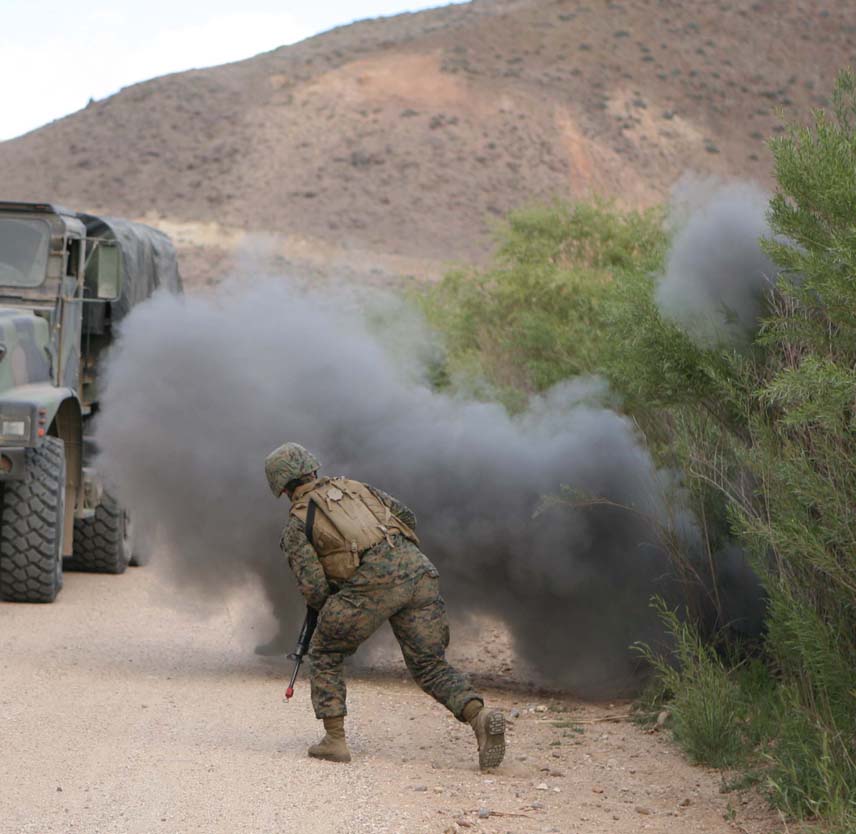
According to the Centers of Disease Control and Prevention, since 2006, blasts have been the most common cause of injury among American soldiers treated at Walter Reed National Military Medical Center.
(U.S. Marine Corps photo/Released)
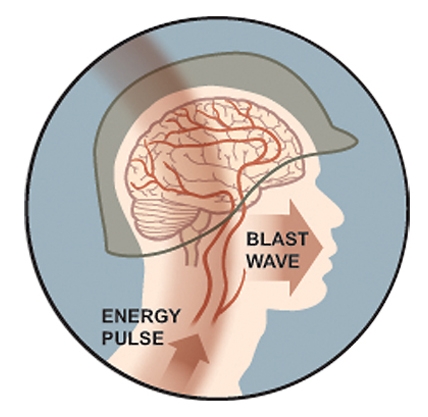
An explosion generates a blast wave traveling faster than sound and creating a surge of high pressure immediately followed by a vacuum. Studies show that the blast wave shoots through armor and soldiers' skulls and brains, even if it doesn't draw blood. While the exact mechanisms by which it damages the brain's cells and circuits are still being studied, the blast wave's pressure has been show to compress the torso, impacting blood vessels, which then send damaging energy pulses into the brain. The pressure can also be transferred partially through the skull, interacting with the brain.
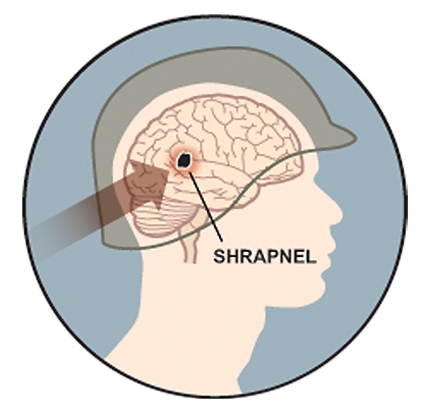
Shrapnel and debris propelled by the blast can strike a soldier's head, causing either a closed-head injury through blunt force or a penetrating head injury that damages brain tissue.
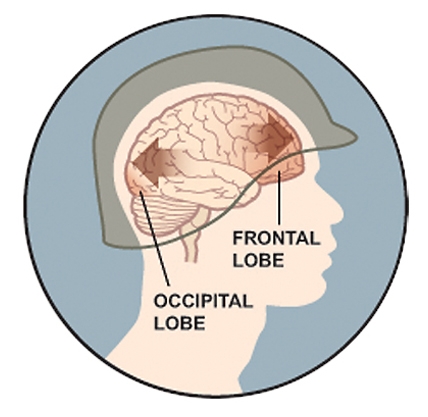
The kinetic energy generated and released by an explosion can accelerate a soldier's body through the air and into the ground or nearby solid object. Once the body stops, the brain continues to move in the direction of the force, hitting the interior of the skull and then bouncing back into the opposite side, causing a coup-contrecoup injury.

Graphic by Al Granberg, Krista Kjellman-Schmidt, and ProPublica. Used with permission. Third-party use restricted. www.propublica.org.
Related Content:
Posted on BrainLine January 24, 2011. Reviewed July 25, 2018.
Comments (4)
Please remember, we are not able to give medical or legal advice. If you have medical concerns, please consult your doctor. All posted comments are the views and opinions of the poster only.
chuck replied on Permalink
2013 travelling 105 km/h come up behind a transport truck, trailer cover in tarp piece of ice came off tarp sliced throgh the windshield ticked the dash board and exploded in my face. the explosion engulfed my entire head 3 yrs later i was told i had a closed head injury i believe i am still suffering have never seen a specialist
Richard replied on Permalink
Richard replied on Permalink
While going to a business meeting, a foreign (perhaps Russian) military surplus truck rear-ended my Chevy . There was an explosion, perhaps from the hydrogen-turbine engine of the offending vehicle that I later learned was unlicensed and uninsured in WA state. I was dazed. An over-pressurization wave, I later learned passed into my vehicle compartment and traveled up my back and on my head. I later learned that cavitation in the cerebral spinal fluid had been created. Within about 6 weeks the cavitation had traveled to my brain and did damage that was manifested with slurred speech and slowed thought processes. In June I went to the ER after there were "stabbing"- like pains in my right temple among many other symptoms of possible subarachnoid hemorrhage in the subarachoind space of the brain between the 2 sacs surrounded my brain. There was a 2nd on 10/28/2010 having the same symptoms that led to a "911" call and the ER again. This again was a possible Subarachnoid Hemorrhage. But it wasn't identified by the MDs. There was no CT Scan of my brain. But there was an angiogram of my heart eventhough I had demanded a TBI Specialist about 8 - 10 times to multiple MDs. Apparently, none was called. This is an example of MD, cardiologist PRIDE, that could have cost me further debilitation or death. Beware of overacting based upon PRIDE and the hope for personal kudos when others can be injured by the lack of common sense to self-benefit - it can destroy ones life and those of others.
Anonymous replied on Permalink
Thank you for this site and course. I have a friend who is dealing TBI from his military service in Afghanistan. In further educating myself through this site , it is my desire to educated beyond what he has shared to fully understand and support him.
God Bless
Shannon